Protecting business data is an important part of maintaining reliable operations, but having copies of important files does not automatically mean a business can recover quickly after a cyber incident. For organisations comparing Cybersecurity Services Sydney, understanding the difference between data backup and disaster recovery can help identify potential risks, reduce unnecessary downtime and support a practical business continuity strategy.
Many Australian businesses rely on cloud applications, customer databases, accounting platforms, email and shared documents to manage everyday activities. If these systems become unavailable because of ransomware, hardware failure or accidental deletion, the disruption can affect employees, customers and essential business processes.
A backup helps preserve information. Recovery involves restoring access to the information, applications and systems needed to continue operating.
Although these activities are closely connected, they serve different purposes and require careful planning.
Backup and recovery are often discussed together, but they are not interchangeable.
A backup creates a separate copy of information that may be needed if the original data is lost, damaged or changed.
Recovery is the process of restoring that information and, where necessary, rebuilding the systems that make it usable.
For businesses reviewing Cybersecurity Services Sydney, understanding this distinction is an important first step towards improving operational resilience.
What Data Backup Means for Australian Businesses
Data backup involves copying important business information to a separate location or storage environment.
This information may include financial records, customer databases, employee documents, emails, project files and application settings.
The purpose is to preserve information so it can be restored if the original becomes unavailable.
Backups may be stored on local devices, dedicated backup systems, remote servers or cloud-based platforms.
The appropriate arrangement depends on the type of information, how frequently it changes and how important it is to everyday operations.
For example, a business that updates customer records throughout the day may require more frequent backups than one that stores older documents that rarely change.
Backup processes can also be automated to reduce reliance on employees manually copying files.
However, automation does not guarantee that every important file is protected.
Businesses still need to confirm which information is included, whether backup jobs complete successfully and how long previous copies are retained.
Security is equally important.
Backups should be protected against unauthorised access, accidental deletion and malicious changes.
A reliable backup strategy is therefore not simply about creating additional copies. It involves making sure those copies contain the right information and remain accessible when they are needed.
How Cybersecurity Services Sydney Support Recovery
Recovery begins when business information, applications or systems need to be restored following an interruption.
In a simple situation, recovery may involve restoring an accidentally deleted document.
In a more serious incident, the organisation may need to rebuild servers, restore applications, reconnect employees and verify that business systems are operating correctly.
These activities can require considerably more work than retrieving individual files.
For example, a business may have a complete backup of its accounting database but still be unable to use it if the accounting application or supporting infrastructure is unavailable.
The organisation may need to restore the application, configuration settings, user permissions and related services before staff can resume normal work.
This is why Cybersecurity Services Sydney providers may consider both backup protection and disaster recovery planning.
An effective approach identifies what needs to be restored, the order in which systems should return and who is responsible for each stage.
It should also include restoration testing so the business has evidence that its recovery procedures can work in practice.
Why Backups Alone Cannot Guarantee Business Continuity
A business may perform daily backups and still experience a prolonged interruption after a cyberattack or major equipment failure.
The reason is that restoring information is only one part of returning to normal operations.
For organisations assessing Cybersecurity Services Sydney, the wider question is how essential work will continue while technology systems are unavailable.
What Happens When Business Systems Become Unavailable?
Several types of incidents can interrupt access to business systems.
Ransomware may encrypt important files, while a compromised account could allow an attacker to delete or alter information.
Hardware failure can prevent access to locally stored data, and accidental changes may affect shared documents or application settings.
Cloud services can also experience disruptions that prevent employees from accessing information even when the data itself has not been permanently lost.
The effect depends on which systems are affected.
An accounting firm may be unable to retrieve client records or process financial information.
A retailer may struggle to manage orders or communicate with customers.
A construction business may lose access to project documents, schedules or supplier information.
These are general examples of possible operational impacts, not accounts of specific incidents.
In each situation, the organisation needs more than a backup file.
Employees need functioning applications, suitable access permissions, connectivity and clear instructions about how work should continue.
The longer these services remain unavailable, the greater the potential disruption to ordinary business activities.
The Connection Between Recovery Planning and Business Continuity
Business continuity focuses on maintaining essential operations during a disruption and returning to normal working arrangements afterwards.
Disaster recovery is one part of that broader process.
For example, an organisation may need a temporary method for contacting customers while its usual communication platform is unavailable.
Employees may require alternative access to important records, or managers may need a process for authorizing urgent transactions.
Business continuity planning should identify which activities are essential and how they can continue when normal systems are interrupted.
Disaster recovery then addresses how the affected technology will be restored.
These arrangements should work together.
A business may restore its files successfully but still face delays if employees cannot access the relevant applications.
Similarly, a recovery plan may restore a server without considering whether the network or authentication services it depends on are available.
For organisations exploring Cybersecurity Services Sydney, reviewing these dependencies can reveal gaps that ordinary backup monitoring may not identify.
A practical continuity plan should reflect the organisation’s actual operating requirements rather than assuming all systems are equally important.
Choosing the Right Backup and Recovery Strategy
There is no single backup arrangement that suits every Australian business.
The appropriate strategy depends on the information being protected, how often it changes and how quickly operations need to resume after an interruption.
When reviewing Cybersecurity Services Sydney, businesses should consider both the security of their backups and the time required to restore essential services.
Cloud, Local and Offsite Backup Options
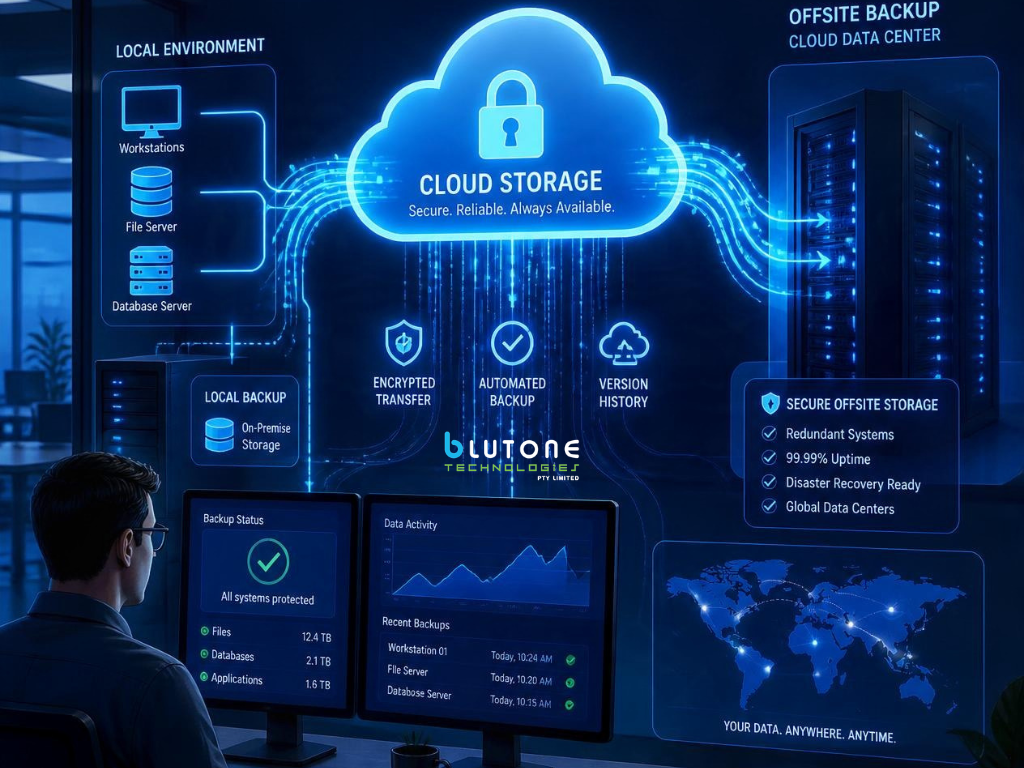
Cloud backup involves storing protected copies of business information in a remote service or cloud environment.
This can reduce dependence on a single office location or physical storage device.
However, cloud backup arrangements still require suitable access controls, retention policies and monitoring.
Local backups may allow data to be restored without first downloading large volumes of information over an internet connection.
They can be useful where rapid access to substantial amounts of data is important.
However, a local backup can be vulnerable if it is affected by the same incident as the original systems.
For example, ransomware may compromise backup storage that remains continuously accessible from an infected network.
Offsite backups provide another layer of protection by keeping copies away from the primary working environment.
Some businesses combine local and remote backups to address different recovery needs.
Regardless of the storage method, backup copies should be protected through appropriate permissions, encryption and separation from production systems.
Where supported, immutable or otherwise protected backups can help prevent copies from being altered or deleted during a defined retention period.
It is also important to distinguish cloud synchronisation from independent backup.
Services that synchronize files across devices can be useful for collaboration, but changes or deletions may also synchronize.
Version history and retention features can provide some protection, although their capabilities and limitations depend on the platform and configuration.
Businesses should confirm whether their cloud arrangements provide the independent recovery capability they require.
Setting Recovery Time and Data Loss Expectations
Two useful concepts in recovery planning are Recovery Time Objective and Recovery Point Objective.
Recovery Time Objective, commonly called RTO, describes the target time within which a system or service should be restored after disruption.
Recovery Point Objective, or RPO, describes the maximum acceptable amount of data loss measured in time.
For example, a business may determine that an essential ordering system should be restored within four hours.
That would establish an RTO of four hours.
The same business might decide that losing more than one hour of transaction records would be unacceptable.
That would establish an RPO of one hour.
These are illustrative planning examples, not guaranteed recovery outcomes.
Meeting an RTO depends on factors such as system complexity, backup availability, staffing and recovery procedures.
Meeting an RPO depends partly on backup frequency and the ability to restore information to a suitable point.
Different applications may require different objectives.
A customer-facing service may need to return quickly, while an archive used occasionally may tolerate a longer restoration period.
Businesses should set realistic objectives based on operational needs and then determine whether their backup and recovery arrangements can support them.
Protecting Business Data Against Cyber Threats
Backup security is an important part of wider cyber risk management.
Creating multiple copies of business data provides limited protection if those copies can be compromised or deleted through the same attack that affects the original systems.
For organisations considering Cybersecurity Services Sydney, protecting backup environments should be treated as a separate security responsibility.
Ransomware Protection and Cyber Risk Management
Ransomware is a form of malicious software that can encrypt files or disrupt access to systems.
Some attackers also steal information and threaten to release it.
This means recovering encrypted files does not necessarily resolve every consequence of an incident.
A business may restore operations from backup while still needing to investigate whether sensitive information was accessed or disclosed.
Backup systems should therefore be protected through appropriate cybersecurity controls.
These may include strong authentication, restricted administrative permissions, secure access management and separation from production systems.
Where suitable, businesses may also use offline or immutable copies to reduce the risk of attackers modifying or deleting recovery information.
Regular software updates, endpoint protection, phishing awareness and monitoring also contribute to reducing cyber risk.
However, none of these controls can guarantee that every attack will be prevented.
Cyber Risk Management involves identifying relevant threats, understanding their potential business impact and choosing measures that reduce exposure to an acceptable level.
A well-protected backup is valuable because it can provide a recovery option after certain incidents.
It should not be treated as a replacement for prevention, detection or incident response.
Why Regular Recovery Testing Matters
A backup process can report that a job completed successfully without proving that an entire business system can be restored.
This is why recovery testing is important.
Testing helps confirm whether backup files can be accessed, whether they contain the required information and whether the restoration procedure works as expected.
For an individual document, this may involve restoring a previous version and checking that it opens correctly.
For a business application, testing may involve restoring a database alongside the application and configuration settings needed to use it.
More complex recovery exercises may examine how several systems can be restored together.
Testing can also reveal missing permissions, outdated instructions, unavailable software or dependencies that were not previously considered.
The Australian Signals Directorate’s Information Security Manual recommends testing the coordinated restoration of data, applications and settings as part of disaster recovery exercises.
For Sydney businesses using multiple cloud and local systems, testing provides an opportunity to identify these gaps before a serious incident occurs.
The frequency and scope of testing should reflect how critical the systems are and how frequently the environment changes.
Backup and Recovery Requirements for Different Industries
Businesses do not all have the same recovery priorities.
The type of information they hold, their operational responsibilities and any applicable regulatory requirements can influence how backup and recovery arrangements should be designed.
When comparing Cybersecurity Services Sydney, organisations should consider whether a proposed approach reflects their industry and the systems they depend on.
Cybersecurity for Financial Services and Sensitive Data
Financial services organisations may manage sensitive customer records, transaction information, financial documents and systems essential to daily operations.
Loss of access to these systems can affect service delivery, reporting and customer communications.
Recovery planning may therefore need to consider data confidentiality, integrity, system availability and relevant legal or regulatory responsibilities.
For certain APRA-regulated organisations, Prudential Standard CPS 230 Operational Risk Management establishes requirements relating to operational risk and business continuity.
The standard, which came into effect on 1 July 2025, applies to relevant APRA-regulated entities, including banks, insurers and superannuation funds.
It does not automatically apply to every Australian business offering financial services.
Other organisations may have different obligations under privacy legislation, contractual arrangements or applicable industry requirements.
When considering Cybersecurity for Financial Services, businesses should identify which requirements apply to their circumstances.
This includes understanding how information is protected, which services are critical and what recovery capabilities are needed.
Technical arrangements should support those responsibilities without assuming that purchasing a particular cybersecurity product automatically establishes regulatory compliance.
Cybersecurity for Business Across Sydney Industries
Cybersecurity for Business should reflect the way each organisation operates.
Professional services firms may depend heavily on email, cloud document systems and confidential client records.
Retail businesses may rely on point-of-sale platforms, inventory management and online ordering systems.
Construction businesses may need access to project documents, supplier information and scheduling applications.
Healthcare providers may have additional considerations involving sensitive records and systems needed to deliver services.
Although the technology differs, the underlying question is similar.
Which systems are essential, and how would the organisation continue operating if they became unavailable?
For some businesses, email may be the first service that needs restoring.
For others, access to an accounting platform, customer database or specialized application may be more urgent.
Organisations should identify these priorities before choosing backup frequency, storage arrangements or recovery objectives.
This approach helps ensure technology decisions reflect business needs rather than applying the same configuration to every workplace.
Understanding Managed Cybersecurity and Recovery Support
Not every organisation has the internal resources to manage backup systems, monitor cybersecurity threats and coordinate recovery after an incident.
External providers may assist with some or all of these responsibilities.
However, service descriptions can vary considerably.
Businesses comparing Cybersecurity Services Sydney should understand exactly what is included before entering an agreement.
What Managed Cyber Security Services May Include
Managed Cyber Security Services can involve ongoing monitoring, endpoint protection, identity security, vulnerability management and assistance with incident response.
Some providers also offer backup monitoring, cloud security reviews and disaster recovery planning.
However, managed cybersecurity and managed backup services are not necessarily the same thing.
A provider may monitor security alerts without being responsible for restoring business applications.
Another service may manage backup schedules but exclude complete disaster recovery testing or support during a major incident.
These distinctions should be clarified before a business relies on the arrangement.
Ask whether backup failures are monitored, how alerts are handled and who is responsible for resolving problems.
It is also important to understand whether restoration tests are included and how frequently they occur.
If an incident affects several systems, the business should know who coordinates recovery and which activities remain its responsibility.
Clear agreements help prevent confusion during a disruption.
Choosing a Cybersecurity Company in Australia
When choosing a cybersecurity company in Australia, businesses should compare the provider’s actual capabilities with their operational requirements.
Start by explaining which systems are essential and what level of downtime the organisation can tolerate.
Ask how the provider approaches backup protection, recovery planning and testing.
It is also worth discussing responsibilities for Microsoft 365, cloud applications, local servers, employee devices and other relevant systems.
Service agreements should clarify response arrangements, security monitoring coverage and any separate charges for recovery work.
Businesses should also understand who owns the backup data and how it can be accessed if the service agreement ends.
For organisations researching Cyber Security Services Australia, local knowledge and clear communication can be useful, but these factors should be considered alongside technical expertise and documented responsibilities.
A suitable provider should be able to explain what is protected, how recovery would work and which limitations remain.
The aim is to establish a practical arrangement rather than rely on broad promises of complete protection or immediate recovery.
Building a Practical Backup and Recovery Plan

A useful backup and recovery strategy should help a business understand what it can recover, how recovery will be managed and what happens while essential systems are unavailable.
It should also be reviewed as the organisation adopts new software, changes infrastructure or takes on additional responsibilities.
For businesses exploring Cybersecurity Services Sydney, the final step is turning technical arrangements into a practical plan that can be followed when something goes wrong.
What to Ask Cybersecurity Services Sydney Providers
When discussing backup and recovery services, begin by identifying the systems that matter most to everyday operations.
Ask how frequently important information is backed up and whether the current schedule reflects how often that information changes.
Discuss where backup copies are stored and how they are protected against unauthorised access or deletion.
It is also important to understand how long previous copies are retained.
Retention requirements may differ between ordinary working files, business records and information subject to legal or contractual obligations.
Ask whether restoration procedures have been tested and what those tests actually covered.
Restoring a single document does not necessarily demonstrate that a complete application or business service can be recovered.
Businesses should also discuss realistic recovery time and data loss objectives.
If an incident affects multiple systems, clarify which services will be restored first and who coordinates the work.
Finally, confirm how employees and management will communicate during a disruption.
These discussions can reveal whether the organisation has a complete recovery strategy or simply a collection of backup tools.
Making Backup and Recovery Part of Everyday Operations
Backup and recovery planning should not be completed once and then forgotten.
Business environments change as new applications, employees, cloud platforms and devices are introduced.
These changes can create gaps if backup arrangements are not reviewed regularly.
For example, a business may adopt a new customer management system without including its information in existing backup processes.
Another organisation may move files into a cloud platform without reviewing the available retention and recovery features.
Regular reviews help identify these changes and keep responsibilities clear.
Recovery exercises also provide an opportunity to update documentation and confirm that employees understand what to do during an incident.
Blutone Tech, also known as Blutone Technologies, provides cybersecurity and managed IT services for Sydney businesses.
Its published services include cybersecurity monitoring, Microsoft 365 protection, backup and recovery readiness, and support for business continuity planning.
For organisations reviewing existing arrangements, Blutone Tech can be a relevant provider to contact about backup coverage, restoration testing and broader cybersecurity requirements.
The priority should be understanding the business’s current risks and identifying practical improvements rather than adding technology without a clear purpose.
A backup may preserve important information, but recovery determines how that information becomes useful again after an interruption.
For Sydney businesses, a reliable cybersecurity strategy should address both.
If your organisation is uncertain whether its backups could support a real recovery, contact Blutone Tech to discuss a technology assessment and identify where additional protection or recovery planning may be needed.